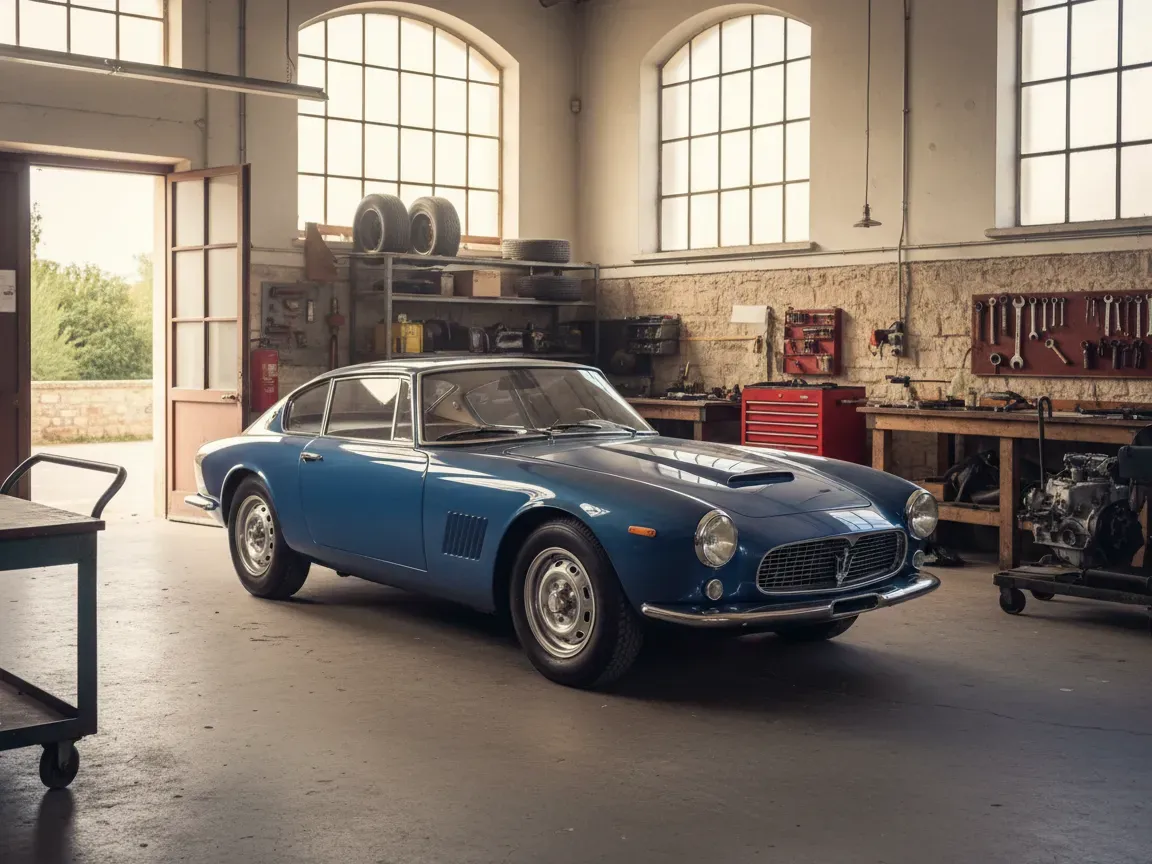
Few barn finds rival the drama of a lost Italian thoroughbred emerging from decades of desert obscurity. Chassis 103 064, the very first Maserati 5000 GT bodied by Pietro Frua, vanished from public record for nearly thirty years before an ambitious international effort brought it back into the light. Its survival and meticulous restoration mark a monumental chapter in vintage motoring history.
A Royal Masterpiece Born for Exclusive Speed
The Maserati 5000 GT originated from a direct request by the Shah of Iran, who wanted the immense power of the 450S race car packaged inside a road-going gran turismo. Maserati answered by marrying a race-derived 5.0-liter V8 engine with a reinforced 3500 GT chassis. The result was an exceptionally fast, prohibitively expensive machine tailored solely for heads of state, industrial titans, and royalty.
Because these cars were built to order, Maserati collaborated with Italy’s finest coachbuilders. While Touring, Allemano, and Vignale shaped several bodies, Pietro Frua penned one of the most striking designs. Frua gave the 5000 GT a sharp, low-slung front end, vast glass surfaces, and balanced proportions that stood out among early 1960s exotics. Only a handful of Frua-bodied examples ever left the workshop, making chassis 103 064 an extraordinary artifact from the golden age of bespoke Italian styling.
The Mystery of Chassis 103 064 Disappearing into Egypt
Chassis 103 064 made its formal debut at the Geneva Motor Show before entering private hands. Eventually, the vehicle found its way to the Middle East, where it was acquired by an owner in Egypt. By the 1970s, shifting political climates, strict import barriers, and financial hardships caused many high-end exotic cars across the region to sit idle.
As the years rolled on, the car dropped completely off the international collector radar. Historians and marque enthusiasts knew of its existence through original factory build sheets, but its whereabouts remained a total blank. The legendary grand tourer had effectively been swallowed by time, hidden away behind closed compound walls under layers of dust.
How Did a Lost Supercar Survive Thirty Years in the Shadows?
Surviving three decades of storage in an unforgiving desert climate is rarely kind to hand-built mechanicals. The arid Egyptian air proved to be a double-edged sword:
- The lack of road salt and heavy rainfall spared the structural steel chassis from the severe rust rot that claimed many European contemporaries.
- Intense ambient heat deteriorated rubber bushings, dried out the original leather upholstery, and oxidized exposed surface paint.
- Long-term mechanical neglect allowed engine seals to shrink, leaving the quad-cam competition V8 locked in place.
Despite the thick layer of desert grit covering every panel, the car remained fundamentally intact. It escaped the worst fates of classic exotics, such as aggressive backyard modifications, stripped parts, or catastrophic accidents. When scouts finally located chassis 103 064, the car was complete enough to justify an immense, complex international extraction process.
Inside the Four-Year Ground-Up Factory Restoration
Returning the car to Modena required a painstaking logistical and mechanical endeavor. Once repatriated to Italy, craftsmen initiated a complete ground-up disassembly that spanned over four years. Every single component was cataloged and evaluated to distinguish salvageable original metal from items requiring period-correct rebuilding.
Technicians rebuilt the complex 5.0-liter dual-overhead-cam V8 from the crank up, restoring the Lucas mechanical fuel injection system and custom ignition components to exact factory tolerances. The lightweight Frua coachwork was stripped by hand, metal-finished, and repainted in its correct original color. Artisans in Modena sourced period-accurate leather hides and carpeting to trim the cabin exactly as it appeared on the Geneva show floor six decades prior.
Authenticating Provenance with Maserati Classiche Certification
Given the historical significance of the Frua prototype, establishing an unbroken line of authenticity was paramount. The restoration team worked in direct collaboration with the Maserati Classiche department, accessing historical build sheets, original technical drawings, and period delivery logs stored in the company archives.
The Classiche certification program scrutinized every chassis stamp, casting code, and panel seam. By validating that chassis 103 064 retained its original structural integrity, matching-numbers drivetrain, and unique Frua styling cues, Maserati officially welcomed the lost vehicle back into its permanent brand registry.
What Makes This Frua Revival a Triumph for Automotive History?
The return of chassis 103 064 fills an essential gap in mid-century Italian coachbuilding lore. During the early 1960s, bespoke coachwork began giving way to standardized assembly lines, making the individual character of cars like the 5000 GT impossible to replicate today.
Preserving this specific automobile provides modern enthusiasts with an uncompromised view into Pietro Frua’s original design language. Rather than existing as a legendary chassis number on yellowed archive paper, the car now stands as physical proof of an era when world-class engineering met absolute exclusivity.
Where Does the Legacy of Chassis 103 064 Lead Next?
The survival of chassis 103 064 proves that rare automotive treasures can endure even the most prolonged periods of neglect when the fundamental foundation remains unmolested. For classic car historians and dedicated collectors, this successful recovery reinforces the idea that valuable lost vehicles are still resting in forgotten corners across the globe, waiting for dedicated preservationists to discover them.
Seeing this Maserati run under its own power demonstrates the value of authentic, archive-driven craftsmanship over rushed modern restomods. By taking the time to rebuild chassis 103 064 to its exact factory specification, the restoration team did not simply save an old car from the desert sand. They restored an indispensable piece of mid-century industrial art that will educate and inspire generations of designers to come.

Alex Ryder
Alex spends his life behind the wheel, testing everything from electric vehicles to rugged off-roaders. He delivers honest, in-depth reviews, reports on the latest industry news, and offers practical maintenance tips for car owners.